
Growth partners to the fitness industry · Since 2014
More members.
More revenue.
Less guesswork.
Black Raccoon is the growth partner behind gyms, health clubs, leisure operators and fitness franchises across the UK. We plug into your team and drive the marketing, sales and retention that move the numbers, and we stay until they move.
✓ Growing fitness businesses since 2014 ✓ Marketing, sales & retention under one roof ✓ Hands-on partners, not report writers
2014
Growing fitness businesses since
£250k+
Annual revenue growth for one partner
37%
Membership growth in four months
700+
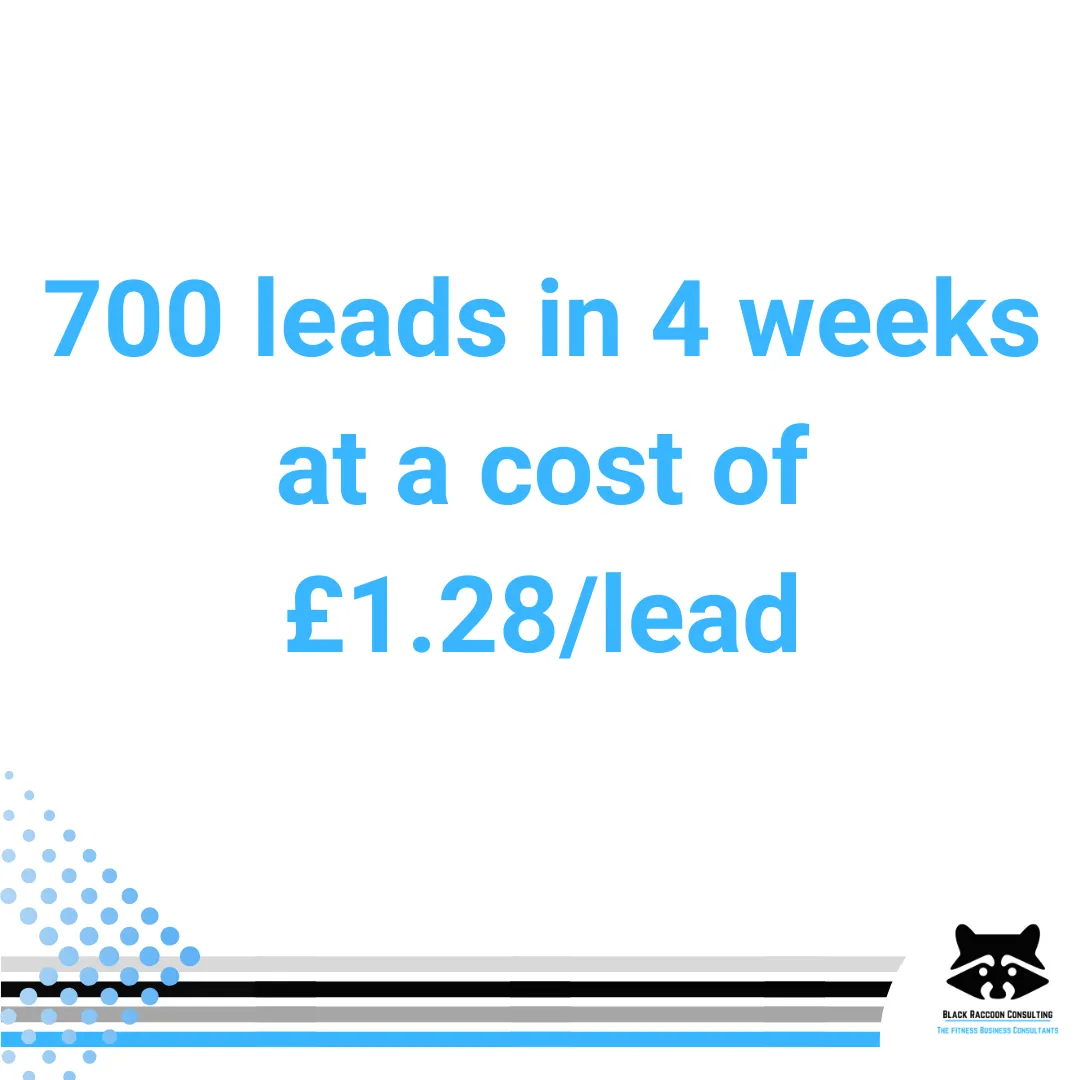
Leads in 4 weeks at £1.28 a lead
Why Black Raccoon
We don't hand you a report. We help you grow.
Most fitness operators don't need more theory. They need someone in the trenches who has built and sold memberships, led teams and run clubs, and who will roll their sleeves up beside them.
A growth plan built around your numbers, your market and your team
Done-with-you delivery across marketing, sales and retention
Weekly accountability, clear KPIs and honest conversations
Access to our partner network: suppliers, tech and talent
What we do
Six ways we grow your business
Pick one lever or pull them all. Every partnership starts with your goals and ends with measurable growth.
📈
Gym Growth Consultancy
Growth audits, strategy and a clear 90-day plan, then we stay in the room to make it happen.
🎯
Gym Marketing & Lead Gen
Campaigns and offers that turn local interest into booked tours and joins.
🤝
Gym Sales Training
Coaching, scripts and accountability that turn enquiries into members.
🔁
Member Retention
Onboarding journeys and engagement systems that keep members longer.
🚀
Gym Launch & Presale
Presale campaigns and launch plans so you open with a full member base.
🌍
Fitness Franchise Growth
Franchise-ready systems and franchisee support to scale your brand.

FitLeads by Black Raccoon
Need more leads? Meet FitLeads.
Our done-for-you digital marketing service: Meta and Google ads, social content and automated follow-up in one joined-up system.
Meta & Google campaigns created and managed for you
Organic social content, Reels and Stories
Instant email, SMS & WhatsApp follow-up
One system for every prospect, with live reporting
How we work
The Growth Partner Method
A simple, proven rhythm that turns ambition into members, revenue and momentum.
01
Diagnose
A deep-dive Growth Review of your marketing, sales, retention, pricing and team to find the gaps costing you members.
02
Plan
A focused 90-day growth plan with clear targets, owners and the quick wins that fund the bigger moves.
03
Execute
We deliver alongside you: campaigns, training, systems and coaching, with weekly accountability.
04
Scale
We measure, refine and double down on what works, so growth becomes repeatable, not lucky.
Who we work with
Built for fitness operators

Independent gyms
Compete with the budget chains on experience, community and results.

Health clubs & leisure trusts
Drive yield, secondary spend and retention across bigger facilities.

Boutique & PT studios
Fill classes, grow memberships and build a premium brand.

Franchises & multi-site groups
Systems, playbooks and franchisee support that scale.

Hotel leisure clubs
Turn the hotel gym into a profitable local membership business.

New gym launches
Presales and launch plans that open with a full member base.
Proof, not promises
700 leads. 4 weeks. £1.28 a lead.
For one partner gym we rebuilt the offer and the ads, tightened the follow-up and coached the team to convert. That is what happens when marketing and sales are planned together.
Trusted by operators across the UK & Europe
Trusted by great operators


Partner stories
“
His expertise in the fitness industry is evident through his targeted approach to identifying and addressing our specific challenges. With his help, we've achieved a stronger market presence and a more robust business model.
Andrew Charalambous
Director, Ignite Fitness
“
Working with Ryan was one of the best things for my business. Hitting a brick wall, Ryan immediately identified where we can change things to see improvements. By implementing fresh, new ideas from Ryan we started to see traction.
Shireen Walker
HubFiit
“
Ryan has supported quite a few of our commercial customers to a very high level. The feedback I have from our customers is that Ryan listens, creates goals linked to their business strategy that deliver results, and above all is very personable.
Blake Fletcher
UK Country Manager, iFIT – Freemotion Fitness
Free growth guides
Steal our playbooks
Attracting the 85%
How to reach the 85% of people who have never joined a gym.

The 90-Day Member
Why the first 90 days decide retention, and what to do about it.

January Sales Blueprint
Plan, staff and convert your biggest month of the year.

Fit for Success
Mastering sales in the fitness industry: the free book by Ryan Charlesworth.
The Inside Track podcast
Real talk from inside the industry
Operators, founders and suppliers share what's really working in fitness right now. Plus our live Education Series webinars on sales, marketing, retention, operations and leadership.
From the blog
Fresh thinking for gym owners
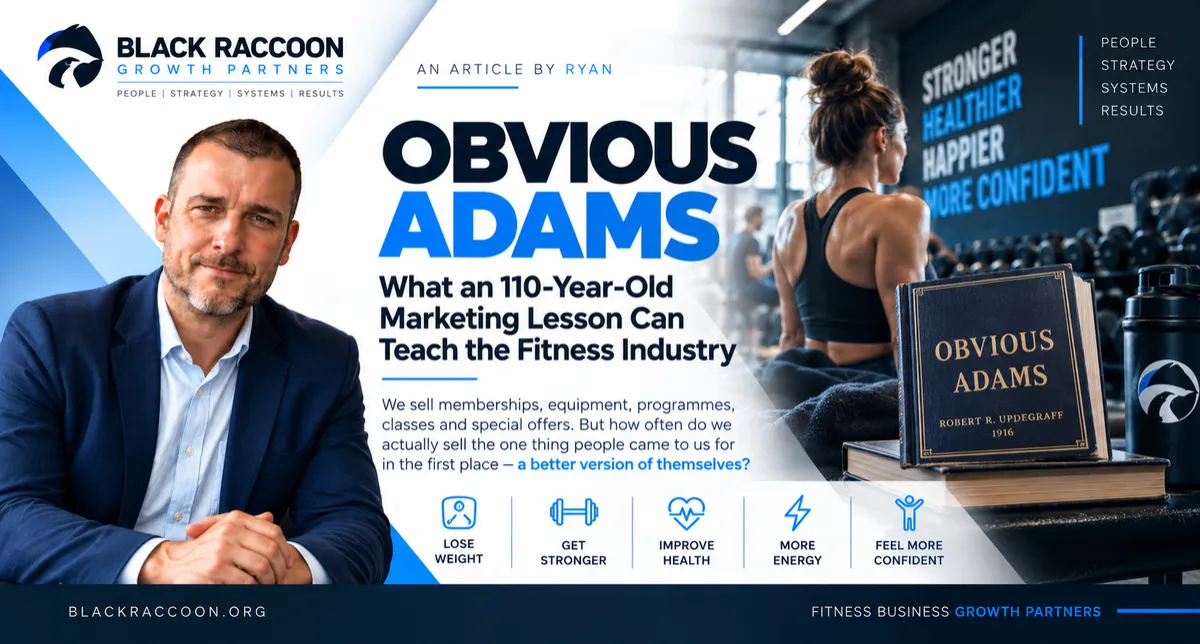
Gym Marketing: Why Selling Results Beats Selling Memberships
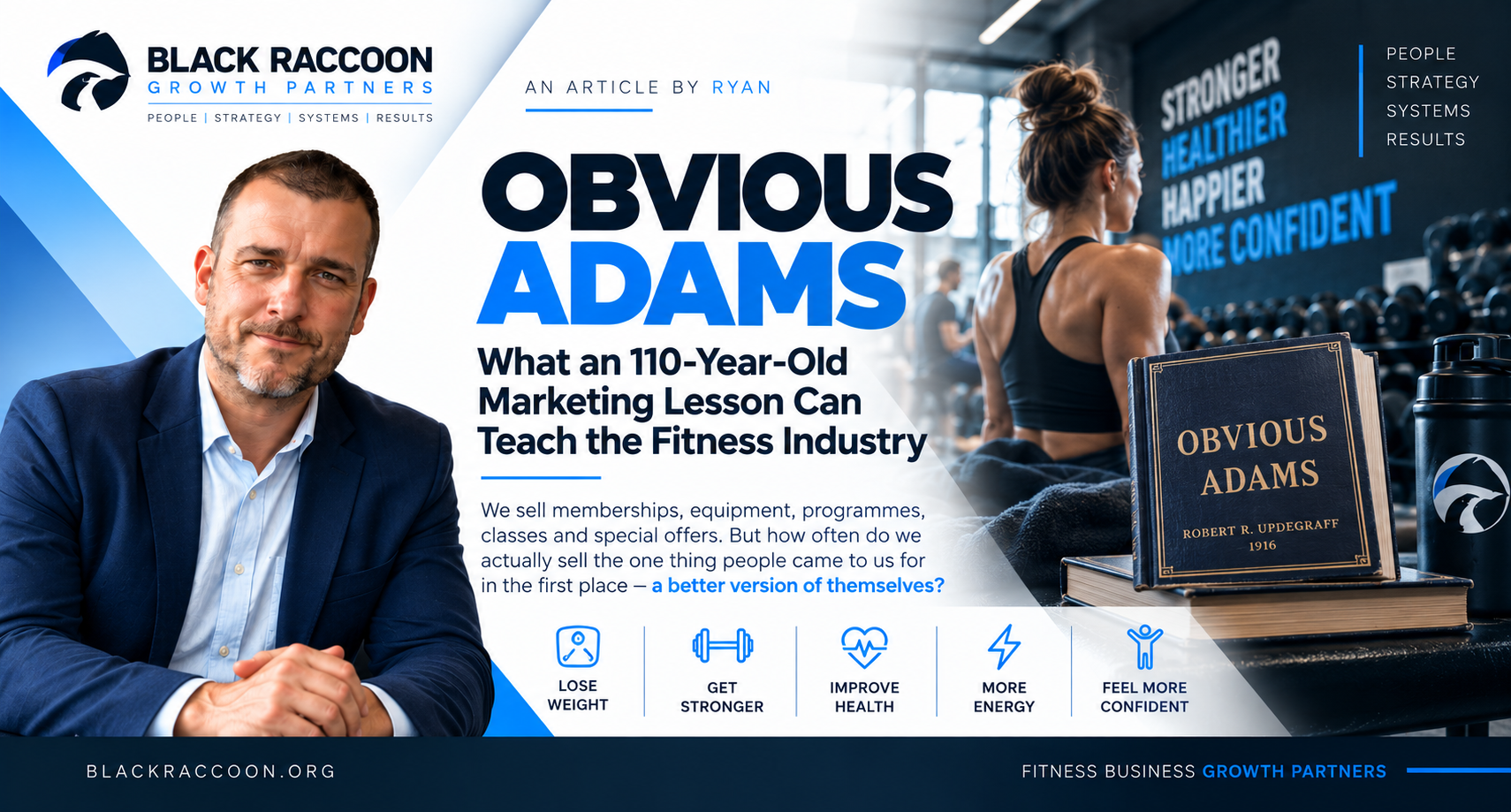
Obvious Adams: Are We Making Gym Marketing Too Clever and Forgetting What People Actually Want?
We sell memberships. We sell equipment. We sell programmes, classes and special offers. But how often do we actually sell the one thing people came to us for in the first place — a better version of themselves?
Yesterday, I read a short book called Obvious Adams, and I have to say, it got me thinking.
It's a wonderfully simple little book about advertising, marketing and the importance of recognising solutions that are often sitting right in front of us. It challenges the idea that the most successful marketing must always be the cleverest, most complicated or most creative.
Sometimes, the most powerful approach is simply to recognise what's obvious.
And the more I thought about it, the more I started questioning some of the marketing we produce within the fitness industry.
Because we have some incredibly talented marketers, designers and agencies working in our sector. We see fantastic-looking campaigns, beautifully produced videos, clever headlines, impressive photography and increasingly sophisticated advertising strategies.
Yet I wonder whether, in our efforts to be creative and different, we're sometimes overlooking the most obvious reason somebody might want to join a gym.
They want something in their life to change.
They want to lose weight, become stronger, feel more confident, improve their health, have more energy, move without discomfort or simply feel better about themselves.
They don't necessarily want a gym membership.
They want what they believe that membership could help them achieve.
And if that's so obvious, why don't we talk about it more?
A 110-Year-Old Marketing Lesson That the Fitness Industry Could Learn From
Obvious Adams, written by Robert R. Updegraff and first published in 1916, tells the story of Oliver B. Adams, an advertising man who builds his reputation by recognising simple, practical solutions that others overlook.
While those around him become caught up in complicated ideas and elaborate campaigns, Adams repeatedly returns to the fundamentals. He considers the customer, the product and what actually needs to happen for a business to succeed.
What I particularly like is that the book doesn't suggest creativity is a bad thing. Instead, it challenges the assumption that an idea must be clever or complicated to be effective.
Sometimes the best answer is so obvious that everybody overlooks it.
And that's the thought I couldn't get out of my head after finishing the book.
We spend enormous amounts of time in the fitness industry discussing advertising creative, lead generation, marketing funnels, membership offers, targeting, conversion rates and customer acquisition costs.
All important things, of course.
But how often do we stop and ask the most basic question of all?
What does the customer actually want, and are we genuinely selling it?
Because I'm beginning to think there's a significant disconnect between what we advertise and what many prospective members are actually looking for.
We Sell the Gym. The Customer Wants the Result.
Take a look at a typical gym advertisement.
It might promote a fantastic facility, state-of-the-art equipment, a new membership offer, unlimited classes or a discounted joining fee.
Some of these campaigns look brilliant. The photography is excellent, the video production is impressive and the messaging is beautifully presented.
But what are we really selling?
We're selling access to a building, equipment or activities.
Now consider the person seeing that advertisement.
They might be 45 years old, overweight, exhausted after work and frustrated that they no longer feel comfortable in their clothes.
They might be 60 and worried about losing strength, mobility and independence.
They might be a young parent who wants more energy to play with their children, or somebody who has been told by their doctor that they need to make changes to their lifestyle.
Or perhaps they're simply unhappy with how they look and feel.
Do any of these people genuinely want access to 100 pieces of equipment?
Some might. But for many, that isn't the motivation.
They want the outcome that they believe exercise could help them achieve.
They want to feel confident when they look in the mirror. They want to walk upstairs without becoming breathless. They want to feel stronger, sleep better, have more energy or improve their long-term health.
They want to be able to do things that have become difficult.
And sometimes, they just want to feel like themselves again.
The gym is the vehicle. The outcome is the destination.
So why does so much of our marketing concentrate on the vehicle?
Let's Be Honest. For Many People, Exercise Isn't Particularly Appealing.
I think this is another uncomfortable truth that our industry sometimes struggles to acknowledge.
We work in fitness. We enjoy exercise, understand its benefits and often surround ourselves with people who feel the same way.
But that doesn't mean the general population shares our enthusiasm.
For plenty of people, exercise feels like hard work.
It takes time, requires effort, can be uncomfortable and doesn't always produce immediate visible results.
There's also the intimidation factor. Someone who hasn't exercised for years might find the thought of walking into a gym genuinely frightening.
They worry about looking foolish, not knowing how to use the equipment, being judged by others or simply discovering that they're nowhere near as fit as they hoped.
And let's not forget that many people have tried exercising before.
They've joined gyms, started diets, downloaded workout plans and promised themselves that this time would be different.
Then life gets in the way, motivation fades or the results don't come quickly enough.
So when we advertise another membership offer, what exactly are we asking them to buy?
In many cases, we're asking them to pay for something they've already struggled to do successfully.
Perhaps that's why we should stop assuming that access to exercise is an attractive enough proposition on its own.
For some customers it absolutely is.
But for the people who struggle most with becoming active, the appeal isn't necessarily the exercise. It's what the exercise could do for them.
Why Weight-Loss Medication Is Such an Interesting Comparison
Look at the enormous interest in GLP-1 weight-management medications.
Why are people willing to spend substantial amounts of money on treatments that require medical supervision, can have side effects and may need to be continued over a significant period?
Because, for eligible patients, these medications can produce meaningful weight-loss outcomes.
People aren't attracted by the process of administering medication. They're attracted by the possibility of achieving something they've struggled to achieve through other approaches.
The treatment offers a credible route towards a desired result.
And that makes me think about how we position fitness.
We know that appropriate physical activity can improve cardiovascular fitness, strength, physical function, mental wellbeing and numerous aspects of long-term health. These benefits are supported by extensive research and public health guidance.
Exercise can also support weight management, although the relationship between exercise and weight loss is complex, and exercise alone doesn't guarantee a particular reduction in body weight.
The important point is that fitness has enormous potential to improve people's lives.
Yet we often market it as a place to go or something to do, rather than a supported process towards an outcome.
There is, of course, an important difference between medical treatment and gym membership. Weight-management medication is clinically assessed and prescribed for appropriate patients, while exercise programmes must reflect an individual's health, capabilities and circumstances.
They aren't interchangeable interventions, and we shouldn't pretend they are.
But the comparison raises a fascinating marketing question.
If people are prepared to invest in solutions that offer a credible route to an outcome, why aren't we doing a better job of demonstrating the outcomes our fitness services can help them work towards?
What If We Sold the Future You?
Imagine changing the starting point of our marketing.
Instead of opening with a picture of a gym floor and a discounted membership, we begin with the person we want to help.
Picture a woman in her forties who hasn't exercised regularly for years.
She's juggling work, family responsibilities and everything else life throws at her. She feels tired, has gradually gained weight and doesn't feel particularly confident.
Now imagine an advertisement that speaks directly to her aspirations.
"Imagine feeling stronger, more energetic and more confident six months from now. We'll help you take the first step."
Or consider someone approaching retirement.
Rather than promoting specialist strength equipment, we could ask:
"What would being stronger and more mobile allow you to keep doing over the next ten years?"
For a busy parent:
"More energy for the things that matter. Let's build a fitness routine that fits your life."
For someone who has joined and left several gyms:
"Tried joining a gym before and struggled to keep going? This time, you won't have to figure everything out on your own."
These messages are not particularly clever.
They're not revolutionary.
But they speak to something real.
They acknowledge what the person wants to achieve and begin explaining how the business can help.
And perhaps that's the obvious approach we've been overlooking.
Of course, the future we're presenting must be credible. We shouldn't promise someone they'll lose three stone, reverse a medical condition or achieve a particular transformation within a fixed period.
But there's an enormous difference between making irresponsible guarantees and confidently communicating the benefits of a properly delivered service.
We can sell the possibility of a better future without promising an identical outcome for everyone.
So Why Don't We Market Outcomes More Often?
I've been thinking about this, and I suspect there are several reasons.
The first is that outcomes create accountability.
If we advertise equipment, classes and membership access, our obligation is relatively straightforward. We provide the facilities and services we've promised.
But when we start talking about helping someone become stronger, fitter, healthier or more confident, we're creating a different expectation.
The customer may reasonably expect us to play an active role in helping them make progress.
And that means we have to think carefully about what we're actually delivering.
It's much easier to sell somebody access to a gym than to accept some responsibility for helping them use that access effectively.
The second reason, and perhaps the more uncomfortable one, is that many gyms simply aren't structured to deliver the level of support that outcome-focused marketing would require.
We sell the membership, process the payment, provide an induction and then largely leave the member to get on with it.
Yes, the member has a responsibility to attend and make an effort. We can't do the exercise for them.
But surely we also have a responsibility to provide an environment and a level of support that gives them a reasonable opportunity to succeed?
If someone joins because they want to become fitter, but nobody helps them establish a routine, monitors their progress or notices when they stop attending, have we really delivered the service they thought they were buying?
Technically, perhaps we have. They purchased access and we provided it.
But commercially and ethically, I think there's a much bigger question.
Are we satisfied simply because someone has become a paying member, or should we be measuring whether we've actually helped them achieve something?
The Biggest Problem Might Not Be Our Marketing. It Might Be Our Business Model.
This is where the lesson from Obvious Adams becomes particularly interesting to me.
We could completely change our advertising tomorrow.
We could create beautiful campaigns showing people becoming stronger, more confident and healthier.
We could replace every equipment photograph with images of real people enjoying the benefits of improved fitness.
But what happens when those customers join?
If the experience is exactly the same as before, have we really changed anything?
We've simply created a more compelling promise without improving our ability to deliver it.
And that could make the problem worse.
I think outcome-focused marketing requires outcome-focused operations.
It means understanding the customer's goals before they join, assessing their starting point, creating an appropriate programme and helping them develop a routine they can realistically maintain.
It means making sure they understand what progress might look like, particularly when improvements aren't immediately visible on the scales or in the mirror.
It means checking in, recognising achievements, adapting programmes and providing encouragement when motivation inevitably fluctuates.
And importantly, it means noticing when someone starts disappearing.
None of this is particularly revolutionary.
In fact, it's all fairly obvious.
But how consistently are we actually doing it?
Imagine If Every Gym Member Had a Clear Plan for Success
Let's consider what a different membership experience could look like.
Someone enquires about joining your club.
Instead of immediately discussing prices and showing them around the equipment, you start by understanding what they're hoping to achieve.
Why now? What would they like to change? What have they tried previously? What's stopped them succeeding before?
You then explain how your club can help.
Not simply which machines they'll have access to, but how their first few weeks will work, what support they'll receive and how you'll help them monitor their progress.
Once they join, they receive a proper starting assessment appropriate to their circumstances, a realistic programme and an agreed plan for attendance.
Over the following weeks, you check in, help them overcome difficulties and review their progress.
If they stop attending, somebody notices.
If they're struggling, somebody helps.
If they're making progress, somebody celebrates it with them.
And if their goals change, the programme changes too.
Now imagine being able to communicate that entire experience through your marketing.
"We don't just give you somewhere to exercise. We help you get started, build confidence, develop a routine and work towards the results that matter to you."
Isn't that a much stronger proposition than simply advertising unlimited gym access?
And isn't it exactly what many prospective members are looking for?
Could Delivering Better Outcomes Actually Be More Profitable?
This is where I think the commercial opportunity becomes particularly interesting.
We spend significant amounts of money acquiring new members, but how much attention do we give to ensuring those members actually benefit from what they've purchased?
If somebody joins, receives very little support, struggles to make progress and eventually stops attending, we've potentially lost a customer who might have remained with us for years.
Now imagine the alternative.
They join, receive guidance, begin making progress and start to feel the benefits.
Their confidence improves. Exercise becomes part of their routine. They build relationships with staff and other members.
They're no longer simply paying for access to equipment.
They're receiving something they value.
It seems reasonable that this could improve retention, referrals and potentially the amount customers are willing to spend on additional services.
But we shouldn't assume that outcome-focused support automatically produces those results. We'd need to measure the relationship between engagement, progress, satisfaction and membership lifetime.
Consider a gym with 1,000 members paying an average of £45 per month.
If improvements in onboarding and member support helped the club retain just 20 additional members who would otherwise have cancelled, that represents £900 in monthly recurring revenue.
Over a further 12 months, those 20 memberships could generate £10,800 in gross revenue, assuming they all remained and paid throughout.
That's before considering additional personal training, referrals or other spending, and before accounting for the costs of providing the additional support.
The figures are illustrative, but they demonstrate why better member outcomes could be commercially valuable.
And here's the really interesting part.
If your members are genuinely achieving their goals, you've also created some of the most powerful marketing material available.
Real stories. Real experiences. Real progress.
Instead of telling people how good your gym is, you can demonstrate how you've helped others.
With appropriate consent, authentic member stories can make the benefits of your service far more tangible than another photograph of an empty gym floor.
Perhaps We've Become Too Comfortable Selling Access
I wonder whether part of the issue is that the traditional gym membership model has made us comfortable selling access rather than outcomes.
We charge a monthly fee, provide the facilities and leave much of the responsibility for using them with the customer.
From an operational perspective, it's a straightforward model.
But from the customer's perspective, it's not always particularly attractive.
Imagine paying £45 every month for something you find difficult, don't particularly enjoy and aren't confident will produce the results you want.
It's not difficult to understand why people hesitate.
Now imagine paying £45, £55 or even more for a service where you feel welcomed, supported and confident that somebody is genuinely interested in helping you improve.
The perceived value could be very different.
I'm not suggesting every gym needs to become a fully coached facility. There will always be a substantial market for low-cost, self-directed exercise, and experienced members may prefer exactly that.
But even budget operators can improve how they communicate outcomes and help customers establish successful routines.
The objective isn't to make every gym identical.
It's to make sure our proposition reflects what our target customers genuinely value.
What Would Happen If We Started Marketing Backwards?
Here's an exercise I'd encourage gym owners and marketing teams to try.
Before creating your next campaign, forget about your membership offers, equipment, facilities and monthly prices for a moment.
Start with the person you're trying to attract.
What do they want to change?
Why does it matter to them?
What worries them about starting?
What has stopped them succeeding before?
And what could their life look like if they made meaningful progress?
Then work backwards.
What support, facilities, programmes and experiences would genuinely help that person?
What evidence do you have that your business can deliver those things?
And how can you communicate that clearly and honestly?
Only then would I start thinking about the creative campaign, the imagery, the headline and the offer.
Because the purpose of the marketing isn't to demonstrate how clever we are.
It's to help the customer understand why our business is relevant to them.
A beautifully produced advert that doesn't connect with the customer's motivation may be less effective than a straightforward message that addresses something they genuinely care about.
And I think that's very much in the spirit of Obvious Adams.
There's a Difference Between Selling a Dream and Selling False Hope
I want to make an important distinction here because I can already imagine some of the criticism.
When I talk about selling the dream or the future version of someone, I'm not suggesting we return to unrealistic transformation marketing.
We don't need to promise dramatic weight loss in 30 days, show misleading before-and-after photographs or imply that exercise can cure every health condition.
That isn't what I'm advocating.
I'm talking about communicating credible, meaningful outcomes and then building the services to support them.
For one person, success might be losing weight. For another, it might be improving strength, walking further, feeling more confident or simply exercising twice a week for three months.
For someone managing a long-term health condition, success might involve appropriately adapting activity to their individual capabilities, with relevant clinical guidance where needed.
Not every outcome is visible, and not every person will progress at the same rate.
The point is that we should understand what success means to each customer rather than assuming everyone wants the same thing.
And we should be confident enough in our service to explain how we intend to help.
The Most Obvious Opportunity Might Be Right in Front of Us
The more I think about Obvious Adams, the more I wonder whether the fitness industry sometimes makes marketing unnecessarily complicated.
We debate advertising platforms, creative strategies, campaign structures, landing pages, artificial intelligence, lead costs and conversion rates.
All of those things have their place, and I spend a considerable amount of my own time working on them.
But perhaps we occasionally forget the most fundamental part of the equation.
People don't usually join a gym because they want a membership. They join because they believe it could help them achieve something they want.
And if we want to attract more of those people, perhaps our marketing should concentrate on demonstrating how we can help them achieve it.
That doesn't mean abandoning creativity, technology or sophisticated marketing systems.
It means making sure those tools are being used to communicate something that genuinely matters.
Because a clever campaign might capture someone's attention.
But a compelling, credible promise of meaningful progress could give them a reason to act.
And a business that actually delivers on that promise has a much better foundation for building long-term customer relationships.
So Here's My Question to the Fitness Industry
What if we stopped spending quite so much time trying to sell our gyms and started concentrating on selling the benefits of what our gyms can help people achieve?
What if our marketing focused less on machines, memberships and offers, and more on confidence, strength, health, independence and the possibility of a better future?
And what if we then accepted the responsibility of helping members work towards those outcomes, rather than simply signing them up and leaving them to it?
Perhaps we'd attract a different audience.
Perhaps we'd create more meaningful relationships with our members.
Perhaps we'd improve retention, referrals and long-term profitability.
And perhaps we'd begin reaching some of the people who have never felt that traditional gyms were designed for them.
I don't think this means we should abandon the marketing strategies we're already using.
I think it means we should question whether we're communicating the most important thing.
Because sometimes, in our efforts to create something clever, we overlook what's sitting right in front of us.
We sell exercise. People want the benefits of exercise.
We sell memberships. People want meaningful change.
We sell access. People want a reason to believe they'll succeed.
And perhaps the biggest opportunity of all is recognising that the real product isn't the gym.
It's what the gym can help someone become.
I'd love to hear what other gym owners, operators and marketers think.
Are we making fitness marketing too complicated?
And more importantly, if outcomes are what customers really want, are we doing enough to help them achieve them?
Ryan Charlesworth
Black Raccoon Growth Partners

FAQ
What does a fitness business growth partner actually do?
We work inside your business, not from the sidelines: diagnosing what is holding growth back, building a focused plan, and delivering it with you across marketing, sales, retention and leadership, with clear KPIs and weekly accountability.
Who do you work with?
Independent gyms, health clubs, leisure trusts, boutique and PT studios, hotel leisure clubs, fitness franchises and new site launches.
How quickly will we see results?
Many partners see early wins within the first 30 to 60 days from sales process fixes, lead follow-up and quick-win campaigns. Bigger shifts in retention and revenue build over 90 days and beyond.
Do you only do strategy, or do you help deliver?
Both. We build campaigns, write scripts, train teams, set up CRM journeys and join your meetings.
Do you work across the UK?
Yes. We are based in Silsden, West Yorkshire and partner with fitness businesses across the UK.
How do we get started?
Book a free Growth Call. No hard sell, just an honest conversation about growth.
Let's talk growth
Tell us where you want to grow
Share a few details and we'll come back within one working day with ideas tailored to your business. Prefer to talk now? Call 07929 369658.
Free, no-obligation Growth Call
Straight-talking advice from people who've run gyms
A clear next step, even if we are not the right fit
Start the conversation
Takes 60 seconds. We reply within one working day.
The growth briefing
Growth plays for gym owners. Straight to your inbox.
Monthly ideas on marketing, sales, retention and leadership from the Black Raccoon team, plus new guides, podcast episodes and Education Series dates. Unsubscribe any time.
Growth partners to gyms, health clubs, leisure operators and fitness franchises since 2014. We plug into your business and drive members, revenue and retention.
Company
07929 369658
[email protected]
Silsden, West Yorkshire, UK
© 2026 Black Raccoon. All rights reserved. Growth partners for the fitness industry since 2014. Privacy Policy